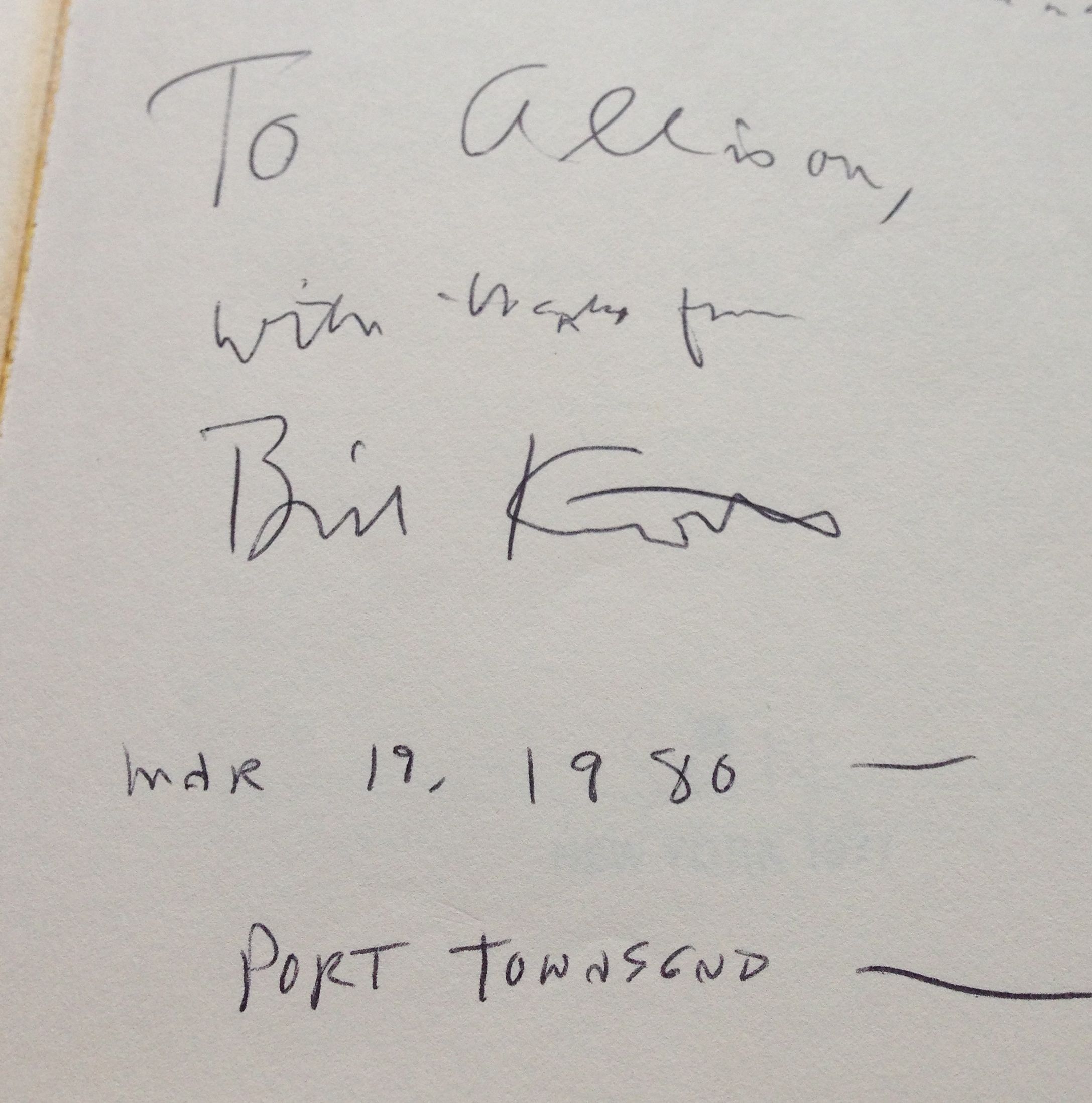
Bill Knott, 1940-2014

Knott1

What was it about those bad-boy poets that I loved so much at 16? Brautigan, Ferlinghetti. And Bill Knott, whose recent death made me think about him and how our paths crossed, twice.

The first time, I was a high school junior attending a week-long poetry workshop at the beautiful old army base Fort Worden, which sits on the tip of a peninsula jutting into Puget Sound. Every day, we students met in seminars with real, true poets. My teacher, Jim Heynen, set out a display of books and invited us to borrow them during the week. On the cover of one book was a cartoon girl, her arms doughy blobs, her eyes red hearts. When I picked it up, Jim told me that the author, Bill Knott, was in residence at the fort, and that if I wanted to, I could knock on his door and talk to him.

I took the book back to my dorm room. In the author photo, Knott seemed worried or distracted, his forehead creased. His hair was messy; it might have been sticky with sweat. Like the girl on the cover, he looked doughy.

Inside was a stream of surreal poems, like this one, in its entirety: “Just hope that when you lie down your toes are a firingsquad.” There was a lot of death, poems about the war in Vietnam, about his own death, like “Goodbye,” which made the Internet rounds after he died: “If you are still alive when you read this,/close your eyes. I am/under their lids, growing black.”

What stirred me most were poems of love and desire, often for a woman named Naomi. In one, he tells Naomi about the “summer fragrances green between your legs.” In another, Naomi’s face is the “altar where my/heart is solved.” In another, “I breathe your/heartbeat, Naomi.” I wanted to be loved like that, to love like that.

I was afraid to bother the famous poet, but I went anyway. I walked across the fort on a misty afternoon and knocked on the door of his cottage. Long pause. The door opened a few inches. Knott looked just as disheveled as in his author photo.

I told him I was at Fort Worden studying poetry, and that my teacher had suggested I come buy a book from him.

He asked my name and left the doorway. Through the crack in the door, I could see dozens of copies of the book I’d borrowed spread across the floor. When he returned, it was with a copy of his book, signed. He refused to take any money. I was delighted, when I got back to my room, to see that it had a list of poems on the inside flap, as if he had used this copy for a reading.

Almost a decade later, I started my first classes in Emerson College’s M.F.A. program as a fiction writer. Knott was the poetry professor there. Throughout my time at Emerson, he was a kind of apparition, wandering in a raincoat through the halls, not looking at anyone. Still, his presence reminded me of the poet girl I’d been once.

What I wanted then was to be one those bad-boy poets, striding through the world with all that passion and power. There were bad-girl poets, too, of course; Anne Sexton was one I read at the same age. She had the passion, but her power sometimes seemed compromised. I wanted more. It would be some time before I found Sandra Cisneros, Marilyn Hacker, Jessica Hagedorn. Women who could stride like that, burn as bright.
 

Posted in Literature, Writers | Tagged , , , , | 1 Comment

Image

I took my empty book bag to the writing conference that was here in Seattle recently, and I wandered through the book fair and scooped up free tortilla chips at the receptions and waved at my friends across the crowded aisles, and by the time I came home, that bag was so heavy my shoulder hurt.

It all started at registration, where I tried to look like it meant nothing to me that Joy Harjo was a few people ahead. I chatted with a man named Ken, and later I ran into him, sitting in the Gival Press booth, and then we crossed paths on the sidewalk, and what was there to do the next time I saw him but buy Poetic Voices Without Borders? Guess who’s in it? Joy Harjo.

Richard Blanco (poet of Obama’s second inauguration) made me think of Arline, who loves Miami, so I asked him to sign Looking for the Gulf Motel to her.

Tom Spanbauer, that beautiful genius, has a new book out from Hawthorne Books. I took his “Dangerous Writing” class many years ago. I wish I could go back in time and watch him walk into that kindergarten classroom again. (We all got grown-up chairs, but the bathroom sinks were three feet off the ground.) Hawthorne had I Loved You More at their table.

Wednesday night, Arline came down and we celebrated Latino/a writers with Donna Miscolta and Alma García and new friends Ruben Quesada and Brian Kornell.

We were all three degrees of separation by then, and Ruben, it turned out, had organized Queertopia, a reading (12 readers! 120 minutes!) at the Barnes and Noble, which is where Arline and I spent Thursday night. There, I bought Kazim Ali’s Bright Felon, Eduardo C. Corral’s Slow Lightning, and Roxane Gay’s Ayiti. Why those? Because I already had Deborah Miranda’s Bad Indians and Barrie Jean Borich’s Body Geographic. And because, while the authors were signing my books, I could stand really close to them without seeming creepy.

Did I mention lunch with Jennifer Munro, who talked me up to an editor at a really cool press? What kind of writer does that? We’re supposed to be stingy and self-absorbed.

One day – Friday? – I chatted with a professor and graduate student at Ooligan Press. From them I bought Oregon Stories and The Portland Red Guide, by Michael Munk. Next time Arline and I go to Portland, we can check out where radical Marie D. Equi lived in the late 1920s and early 1930s with her lover, Elizabeth Gurley Flynn.

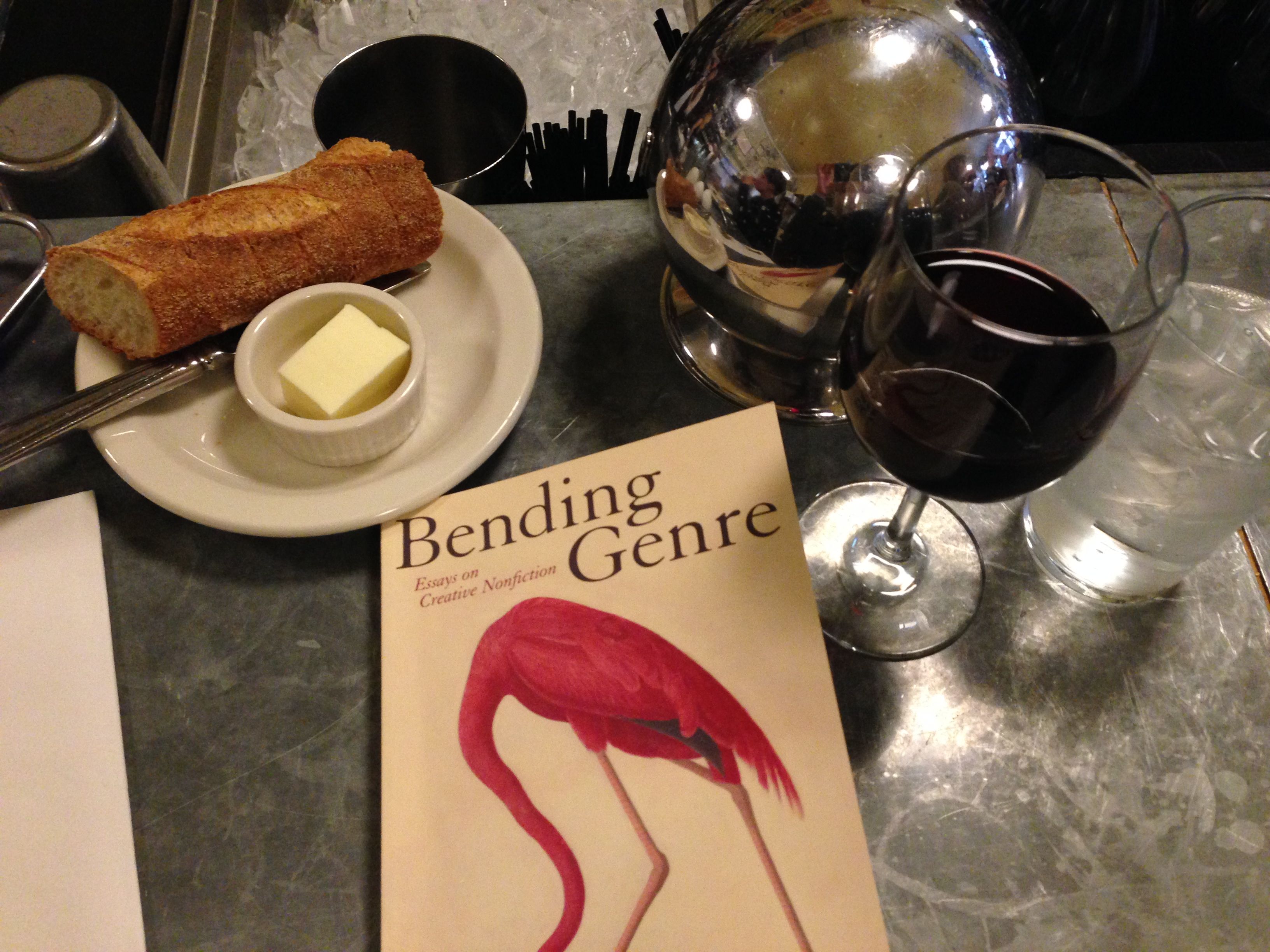
I wasn’t the only one exhausted and overstimulated by the last day, but I managed to make it one more time through the book fair, where I picked up an anthology of craft essays and Frank Bidart’s latest, Metaphysical Dog. Many years ago, when Northwest Bookfest was down on the waterfront, I sat on a folding chair in a drafty pier warehouse and listened to Bidart read. Another beautiful genius.

After lunch at Le Pichet, I carted my books home on the bus. And now, dear Reader, I am reading them.

Posted on by allisongreenwriter | Leave a comment

Doris Lessing, 1919-2013

Image

“I keep four notebooks, a black notebook, which is to do with Anna Wulf the writer; a red notebook, concerned with politics; a yellow notebook, in which I make stories out of my experience; and a blue notebook which tries to be a diary.”  —The Golden Notebook

The Black Notebook — Her guidance counselor, Ms. Fransson, took her aside one day. You’re bored in your language arts class, aren’t you? Ms. Fransson had an open face that looked and looked at her. How about we read some books together, Ms. Fransson said. She gave the girl a list. One of the books was The Summer Before the Dark. What did the girl have in common with a middle-aged woman who takes an escalator to madness (after a sexy summer in Spain)? Unfortunately, nothing.

The Red Notebook — The girl graduated early and spent the nine months before college earning minimum wage as a receptionist. On dead Sundays, she read the Children of Violence series: Martha Quest, A Proper Marriage, A Ripple from the Storm, Landlocked, The Four-Gated City. Each book was longer than the last, the sentences unspooling more and more deliriously. When the minimum wage rose from $3.10 to $3.35, the girl clipped a news article and left it on her boss’s desk. He grumbled but raised her pay.

The Yellow Notebook — She wanted to write. She wanted a wild, feverish affair with writing. She wanted wild, feverish true loves. She would take that escalator to madness if she could just feel and write and feel and write.

The Blue Notebook — The girl, now a young woman, wrote a paper on The Golden Notebook for a graduate theory class. She highlighted passages that still astonished and passages that now made her cringe: “There is only one real female orgasm and that is when a man, from the whole of his need and desire, takes a woman and wants all her response.” Oh no. No, no. Still. She remembered being the girl of sixteen, thirsting in her basement bedroom for an adventurous life. Lessing had showed her one.

The Golden Notebook — Maybe no books are as powerful as the ones read in youth at midnight. The ones that show us an adult world as terrifying as it is exciting. The ones that show us what we might feel, what we might create. What kind of wild, feverish life we might have.

Posted in Literature | Tagged , , , | Leave a comment

Ornaments

Mouse ornament

After my grandmother died in 1994, my girlfriend-at-the-time and I went to my grandfather’s house to help him decorate his Christmas tree. We brought the boxes of ornaments up from the basement and unwrapped the wads of tissue paper. There were ornaments from my grandparents’ trips to Hawaii and Mexico. There was a white satin ball studded with pink beads that I had coveted as a girl. And there were ancient glass balls so fragile that one crumbled into red dust in my hand.

One ornament struck us as hilarious, but, not wanting to offend my grandfather, we waited until he was in the kitchen making us cocoa to laugh. In their later years, my grandparents hadn’t kept up the maintenance on their house, and rats had moved into the basement. The poor little plastic mouse, a couple of inches high with grey velvety flocking, had lost its nose, hands, feet, and ears to a rat’s nibbling.

I tucked the mouse into my pocket. Now, every year when I get out our own box of Christmas decorations, I find the mouse in my stocking and laugh again at the poor thing, its beady eyes staring pathetically from its ravaged face.

It’s easy to laugh at someone else’s deteriorated ornament; I don’t know how my grandmother obtained the little mouse or what it meant to her. Perhaps it was part of a gift from a member of the gardening club. Perhaps it was a remnant of my father’s childhood, although he doesn’t remember it. For whatever reason, she kept it. Many of us who celebrate Christmas have, in our ornament boxes, strings of beads flaking paint, burned out lights, felt Santas missing eyes, nativity sets with two kings.

My parents kept my “stained glass” windows, made of glue and food coloring and decorated with popcorn kernels, long after they had drooped and the kernels had fallen off. For their first Christmas together, my parents had painted rectangles of styrofoam red and green. Those rectangles decorated their tree for several decades, though the glitter had flaked away.

Arline and I were in the beach town of Mazunte, Mexico, when my grandfather died just before Christmas in 2002. We took a taxi into a nearby town, Pochutla, to read our email and that’s when we got the news. He was 93. That night, we lay together in a hammock, looking out at the moon-drenched sea, and talked about my grandfather, who had not been lucid for some time. I had recently sat with him in the hospital while he told me that he had brought the horses over the hill that morning. Those horses would have been cresting an Idaho hill in the 1920s.

While we were in Pochutla to check our email, we had bought a cheap plastic Christmas tree, about a foot high. We set it up in our hotel room and decorated it with tin angels. I will forever associate that trip with my grandfather’s death and the little tree made of wire and green plastic needles.

This year, when I got out the Christmas ornaments, Arline said maybe it was time to get rid of the little tree. We have a fancy full-sized artificial tree now that, with a touch of the remote, blinks white or multicolored or both. And the wooden stand of the Pochutla tree has broken, so that the tree lists backwards, if I can get it to stand up at all.

But I can’t bear to get rid of it. I unfold the wire branches and tuck the tin ornaments inside. I fiddle with the stand until the tree at least stays upright, if at an angle. My thoughts turn to my grandfather bringing the horses over the hill while his blood slowed and his muscles weakened. Deterioration means more to me at fifty than it did at thirty, when the gnawed mouse first made me laugh. I’m more fragile than I used to be, too, but I’m still here.

Posted in Uncategorized | Tagged , , , | 1 Comment

Singing in English

IMG_0672

I never doubted that English belonged to me. Even the most convoluted academic English, studded with the hegemonies, dichotomies, and Foucaultisms of my graduate literary theory seminars, seemed available for my use. I believed that, with practice, I could wield those words through the debates about literature, gender, and power.

Daughter of academics, I’ve been absorbing multiple registers of English since the crib. The first thing I wanted to be when I grew up was a paleontologist, as much for the sound of the word as for the opportunity to dig fossils. One wine-soaked evening, my parents and their friends used the word “subtle” with such intonation that I wondered if it was a swear word. When I couldn’t find it in the dictionary, looking for “suttle,” I knew it was.

The languages of math and biology were less accessible. I didn’t play with numbers, didn’t wonder at the processes of cells. Somehow these bodies of knowledge didn’t translate.

In a recent essay in The New York Times, Eileen Pollack describes how, despite earning a bachelor’s in physics from Yale, she didn’t go to graduate school, mostly because no one told her she could do it, and she believed her advisor’s silence on the topic meant she couldn’t. Years later, she went back to talk to him, and he said her work had been “exceptional.” But she had come to believe that math and physics didn’t belong to her.

Her story reminds me that my social identity as a white, middle-class woman, the very stereotype of an English teacher, can impact my community college students’ perceptions of my discipline. I teach in a college whose population is about 70% students of color, about 25% immigrants and refugees. My students come from Somalia, Ethiopia, Vietnam, India, South Korea, Ukraine, and Mexico. Or their parents crossed borders, and they are growing up with English in school and other languages at home. Some were raised monolingually English, but unlike me, they have been surrounded by different tongues all their lives.

I try to keep in mind that my students’ positions as immigrants, English language learners, people of color, and working class folks may affect their feelings of competence in Dominant American English. To counteract anxiety, I put issues of language at the center of our discussions. We read and write about language and identity, language and prejudice, about self-expression. And I make explicit that English, in all its variations, belongs to them; it’s theirs to use — to tell their stories, report their research, communicate their ideas, and respond to the ideas of others.

One of my students recently posted an essay to her class blog about her multiple languages: Mexican and Puerto Rican Spanish, Tagalog, and English. Listening to English, she wrote, is like “listening to a new music genre for the first time. It can be difficult to understand the lyrics and find the rhythm.” What I hope is that my class will give her a chance to make sense of that music. We get out the lyric sheets and pore over them. We tap the rhythms on our desks. And then we open our mouths and sing.

Posted in Uncategorized | Tagged , | 2 Comments

New Publication: An Essay in Defunct

I’m pleased to have an essay, “Séance,” in the very cool online journal Defunct. It’s about John F. Kennedy, the March on Washington, and other 1960s phenomena. Thanks to editor Amy Butcher for her excellent suggestions.

Posted in Uncategorized | 2 Comments

Will the Circle Be Unbroken

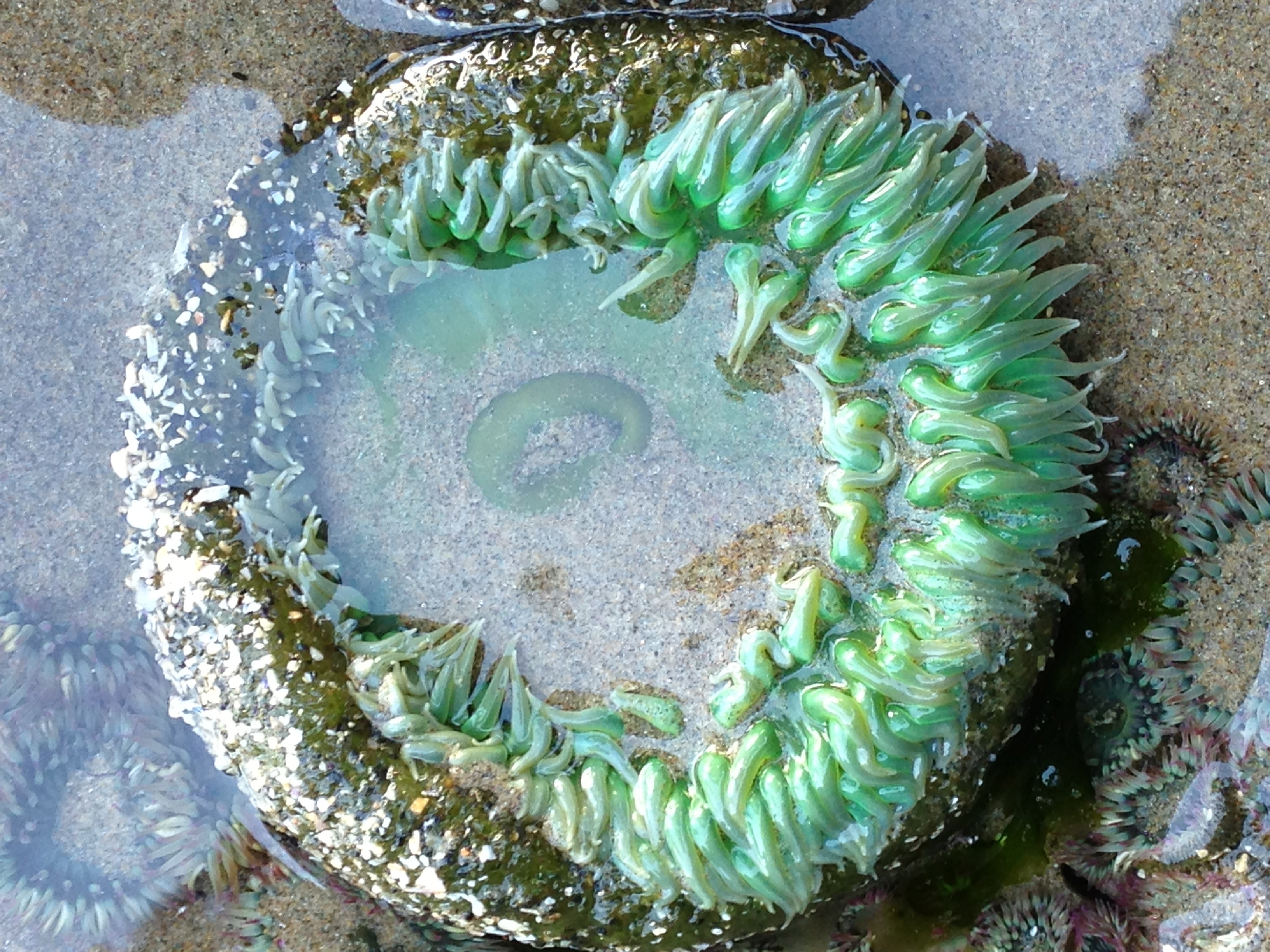
Sea anemone

Shortly after our wedding this month, Arline and I spent some time on the Oregon coast. Every day Arline would ask me: “Are you going to wear your ring to the beach?” Yes, I would say. “Are you going to wear your ring to the coffee shop?” Yes.

Arline was afraid of her ring getting lost or scratched or stolen. Wedding rings are meant to be worn, I said. Her ring was my great grandfather’s, and it hadn’t been lost or stolen while he wore it. The gold has some scratches, but to me that means the ring was much loved.

I had found it interesting to notice, as we developed our secular ceremony with our officiant and friend, Juan, which rituals from the traditional Christian wedding we retained and which we didn’t. The ring vows — I didn’t know there was such a phrase — turned out to be important to us. Of course, we didn’t want to say, “With this ring, I thee wed,” so Arline and I talked for a long time about what rings meant to us and why we were going to wear them.

For me, the circle of the ring symbolized our connection among a sea of intimate circles — my original family, her children and their families, my mother’s and father’s families, our friends and their families. For her, the circle extended backward and forward in time, linking her to my great grandfather and her own ancestors as well as to whoever might wear this ring in the future.

We were walking the stretch of beach past Haystack Rock, encrusted with seagull nests and barnacles, when Arline said, “I wonder if your great grandfather died with this ring on?” Someone must have removed the ring from his finger, soon before or after his death, and cradled it, cherishing the love that had prompted him to keep it all those years. The ring is engraved with his and my great grandmother’s initials and the day of their wedding, January 12, 1909.

Arline held out her hand in the sun, and the ring burned with the heat of that history. I thought of the Iron and Wine song with the almost unbearably sad line: “One of us will die inside these arms.” And one of us will remove the other’s ring. And maybe someone younger will wear it. Or, as I did with my grandmother’s and great grandmother’s rings, melt them together and make something shiny new.

It was Arline’s idea to say, as she slid the ring over my finger, “With this ring I honor the many who have come before us who made this moment possible.” It was mine to add something cheesy: “And I commit my heart and soul to you.” As we spoke our ring vows, I felt the love of our friends and family gathered together. I felt the others, the ones who came before us and the ones who will come after. Because the circle is never broken. It gleams, wheeling us forward and back, ever around.

Posted in Uncategorized | Tagged , | 10 Comments

Summer

Blackberries

Every summer of my childhood, our family climbed into the 1972 copper-colored Valiant and traveled from Green Bay, where my father was teaching at the university, to the Pacific Northwest, where my grandparents lived. There was no air conditioning; we rode with the windows down, the wind roaring through the car. Sometimes we rolled a window up to hold a towel in place, a curtain against the sun. Sometimes my parents got a bag of ice from a gas station, and it would melt between my brother and me on the vinyl seat. We would suck on bits of ice, or roll them around our necks, or throw them at each other.

My mother gave us each a shoebox at the beginning of the trip with small wrapped gifts. We got to open one or two a day. My box usually had a Trixie Belden mystery and books of word puzzles. My brother and I played cards and the alphabet game, looking for the letters on signs and license plates. Occasionally my father would smoke a cigar, and the sweet smell drifted through the backseat.

We left early the first morning, stopping in Wausau for pancakes. One year my dad had to pull over the car a few miles out of the city for my brother to throw up his pancakes. We hooked up with I-94 in Eau Claire and then drove almost without stopping — just for gas and a quick picnic lunch in a rest stop — until we reached Jamestown, North Dakota, where a giant concrete buffalo stood guard on a hill. I was fascinated by the breakfast arrangement at our motel. Coffee, juice, and doughnuts were sold on the honor system, with a bowl marked “kitty.” What would stop someone from eating fistfuls of doughnuts and walking out without paying? And why was a money dish called a kitty? My father always dutifully counted out the coins and left them in the bowl.

The next long day took us from Jamestown to Bozeman, Montana, where my great aunt and uncle, with the funny names of Floss and Shirl, lived in a log house in a mountain valley. Somewhere along this road, we began to see billboards for the Snake Pit outside Spokane. The first billboard read something like “830 miles to the Snake Pit!” We always laughed and called out the Snake Pit signs because we were actually traveling that far, and we knew that the Snake Pit was a little warren of sad buildings that most people, including us, passed by.

The last day brought us to Spokane and my maternal grandparents’ house, where we sat on the cool back patio drinking lemonade and trying to play with their grouchy dachshund Mitzi. We would spend some weeks at their nearby lake cabin, then drive to Seattle for a visit with my father’s parents. And then we would turn around and drive east, passing the Snake Pit signs, waving to the Jamestown buffalo, and leaving our coins in the kitty on our way to Green Bay autumn.

This summer I’ve been reading the work of André Aciman, a writer once called by a reviewer “the prince of nostalgia.” When he was a child, his Jewish family was forced out of Egypt and exiled to Italy. Eventually, he moved to New York, where he writes essays and novels that often explore nostalgia for times and places long gone. It’s no surprise that he is a Proust scholar.

In an essay called “Shadow Cities,” Aciman describes a small New York park that he has grown to love because, among other things, it reminds him of other cities. But what he comes to understand is that he is remembering “not so much the beauty of the past as the beauty of remembering, realizing that just because we love to look back doesn’t mean we love the things we look back on.”

I do not share Aciman’s experience of exile, yet it resonates with me. Until I turned twelve, my family was constantly moving, from the Pacific Northwest to Houston to the Virgin Islands to Green Bay and back to the Northwest. By first grade I had traveled on trains, planes, and long car trips. I learned to love, not just places we visited — for example, the sere landscapes of eastern Washington: the Ponderosa pines, the dry heat, the sweet cool of lakes — but also the movement, the getting there, the travel. And as Aciman suggests, I do not love everything I look back on; I’m sure if I were, right now, driving into a hot North Dakota sun, I would wish I were back in my cool Seattle apartment, drinking chilled wine and looking out on the green park. But I do like to remember.

I’m scrunched down, my bare feet pressed against the back of my mother’s vinyl seat. Hot wind whips the curls around my face. Trixie Belden is sneaking through the dark back yard of a sinister mansion, and my brother, for once, is asleep against the door and not bugging me. Ice melts against my neck. The road stretches ahead. This is summer.

Posted in Uncategorized | 4 Comments

Another Birthday

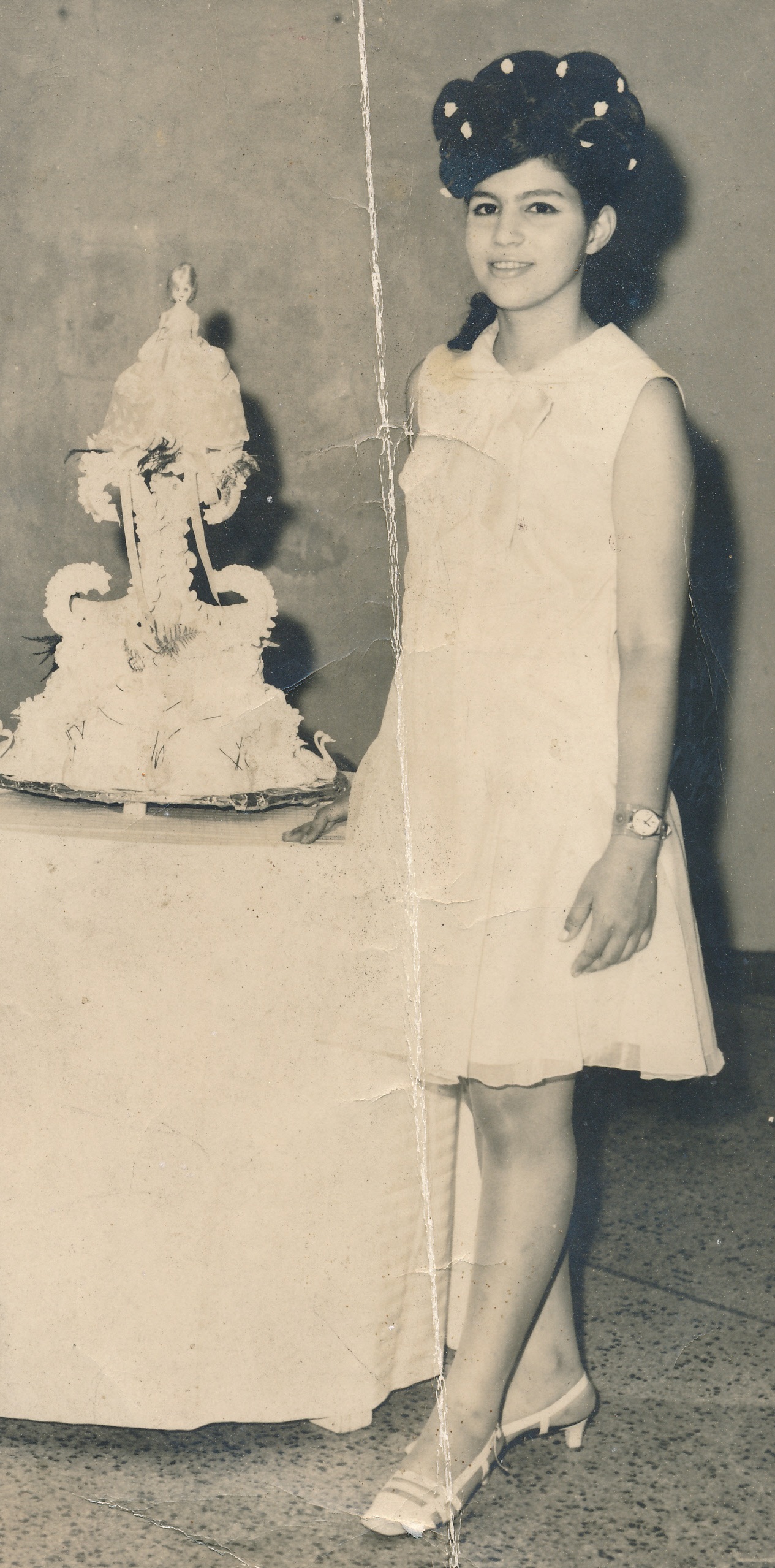
Arline at 15

What saddens me is that I missed the first forty-five of Arline’s birthdays. I missed the debutante party that Arline didn’t even want but for which she gamely wore her hair in a tower. I missed her first birthday in the States. I missed her fortieth, which by all accounts was a fabulous success, with drag queen entertainers and her friend Alberto’s Panamanian tamales.

What cheers me, though, is that I get to share her second forty-five birthdays. Every year I get to remind her all week long: It’s your birthday week! It’s your birthday eve! It’s your birthday!

Arline is not, actually, much of a birthday person. She doesn’t like people making a fuss about her. Many years she wants to go out for a nice dinner but otherwise spend the day quietly. Not all the time. One year, on her birthday, I was in Costa Rica chaperoning a group of students as they studied Spanish. I remember her telling me on the phone that she had decided at the last minute that she didn’t want to be alone, and she made some calls, and the next day a bunch of people showed up to celebrate.

When I asked Arline about memorable birthdays, she reminded me of the time I was determined to make her rack of lamb for dinner. It was ninety degrees and muggy that day, and as I roasted the lamb, the kitchen thermostat ticked up to a hundred and beyond. But I persisted. We sat on the front porch, limp in the heat, poking at baby potatoes in mint sauce and trying to work up an appetite.

This year’s birthday has a big zero in the number. She has never felt so old. But a few weeks ago when we were sitting at a bar in Portland, she struck up a conversation with a young man and mentioned how old she was turning. He said, “Wow, I want your DNA! Can you mainline it into me?” That helped. And then we went to a friend’s wedding reception, and a teenager who was making a video for the couple came around to tape us. Somehow (somehow?) the topic of her birthday came up. The boy didn’t believe her age. How old did he think she was? Arline asked. Forty-eight. We laughed later: to a seventeen-year-old, even forty-eight must seem ancient.

Ancient or not, she’s the most beautiful, funny, smart, and generous person I’ve ever known. Happy birthday, Arline. And if you see her this week, make a fuss about her. She deserves it.

Posted in Uncategorized | Leave a comment

A Birthday

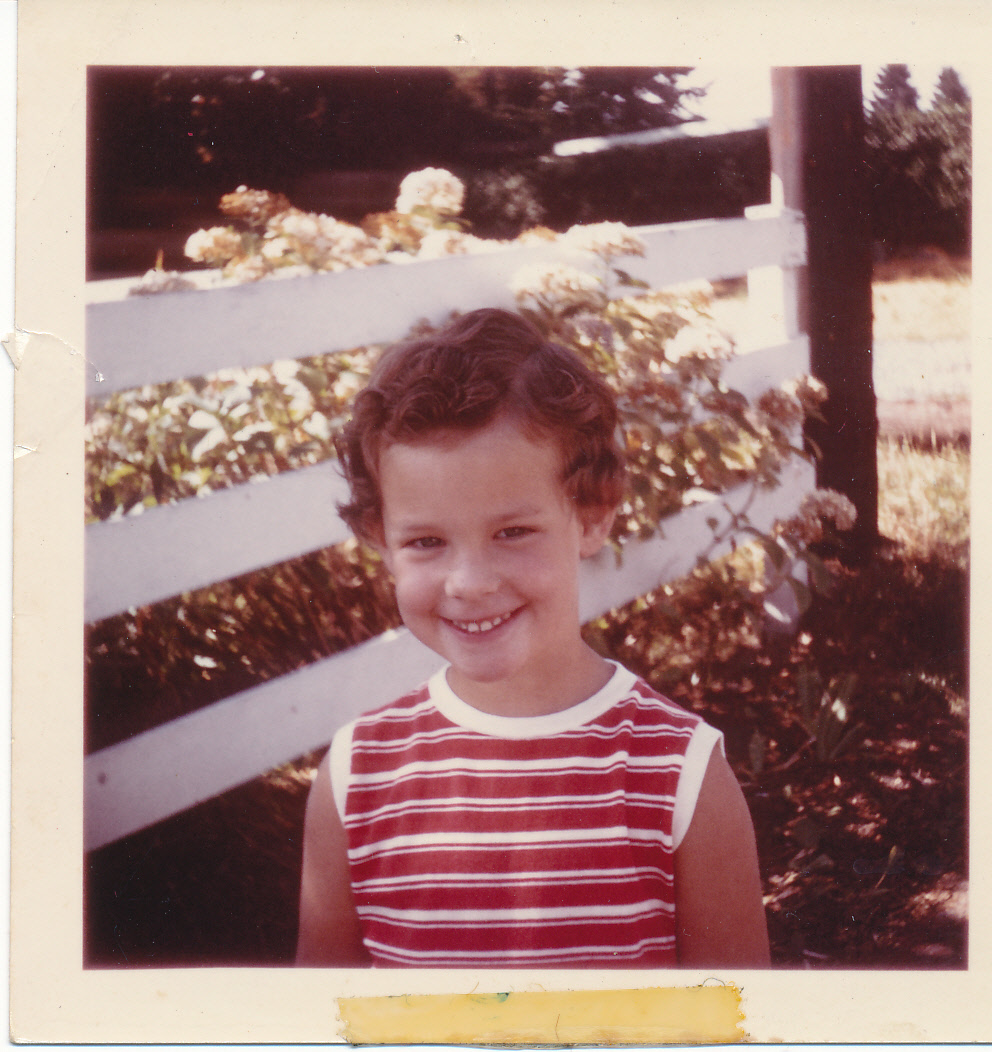
IMG

My mother remembers me playing on the floor of our living room and looking up at her: “I’m three!” I wasn’t quite three yet, but she didn’t contradict me. This story is about a little girl who loves her birthday, loves the event of it, the meaning of it, the celebration of it. She takes pleasure in having a day when she can do whatever she wants. She plans it far ahead of time. For weeks, for example, she checks the weather; will this be one of the few years that the sun shines on her day? She thinks about where she wants to go for breakfast, whether she also wants to go out for lunch. She wants a pretty view: sun slanting across a café courtyard or ferries buoyant on the Sound. She wants to take a walk and then a nap. She wants to listen to Sandy Denny sing “Who Knows Where the Time Goes?” and write in her journal. Gifts aren’t important, but people are: she wants to spend the evening sharing wine, telling stories, laughing. She doesn’t mind being the center of attention, at least on that day. Okay: She likes being the center of attention, especially on that day.

Two of our grandchildren, Giulianna and Liam, are turning three within a week of my birthday this year, and that’s how far from three I am now. I must have once had their apricot skin, their wispy curls, their unself-conscious consciousness. But soon enough my chin broke out in acne, my hair coarsened, and my anxieties bloomed. Soon I was longing for adulthood, for more and more birthdays. In 1984, I wrote, “Friday is my twenty-first birthday. I’ve waited so long. I think it’s the last birthday I’ll wait for.” Years earlier, eighteen had been the magic destination, while “twenty-one seemed a distant dream, hardly worth hoping for.” But here I was, about to hand over my passport for the true stamp of adulthood.

Although I stopped longing for birthdays, I didn’t stop planning them. For my thirtieth, I wanted to dine in the alley behind the Loring Park Café in Minneapolis while the musician played his saxophone from the rooftop. As our reservation time approached, the sky opened and a thunderstorm drenched the city. My girlfriend and I ran through Loring Park, leaping streams. We were shown a table inside the restaurant, where our clothes moldered in the air conditioning. Nothing in my life was going well: I didn’t want to live in this city, hadn’t made progress in my writing career, and wasn’t thriving (although I couldn’t have articulated so at the time) in my relationship with the woman sitting across the table. There was no gleeful declaration: “I’m thirty!” Rain drowned the park outside the café windows.

Sun is forecast for this year’s birthday – hot, low-eighties, summery sun. For several years now I’ve been fretting about this day, a day marking an age so weighty, so significant, so old, that it seems impossible to get through it without an existential meltdown. I’m standing at that passport counter, not sure whether I want the stamp that will let me into this new country. Turn me back! I want to say. Bar my entry! But ending the journey now would be far more disturbing than continuing on.

And the day is shaping up to be a beautiful one. It’s looking like sun will shine on my coffee and pastry in the morning, and nothing is more gorgeous than Arline’s smile across the breakfast table. I’ll probably get a chance to walk and nap, to play music and write in my journal. The evening will bring wine, close family and friends. I’m not likely to gleefully declare my new age, but maybe I was wrong when I was twenty-one; maybe this was a birthday worth waiting for.

Posted in Uncategorized | Tagged , , | 3 Comments