Guest Post

Over at the Hedgebrook blog, I have a guest post this week.

Posted in Uncategorized | Leave a comment

Blog Radio

Image

“Película” was the one word I retained from my semester of high school Spanish. A bracelet of a word, consonants dangling from a chain of short vowels. It means “film.”

I had taken French from seventh through eleventh grade. Faced with yet another independent study with two cheerleaders my senior year, I decided, instead, to start a new language. Mrs. Hill must have trotted us through conjugations: hablo, hablas, habla…. I graduated early, in December, and didn’t continue. The vocabulary of everyday life — mesas y sillas, leche y café — faded, but the word “película” stayed with me, representing everything about Spanish that was different from the two languages I had learned until then: it was more delicate than English, the consonants skipped through rather than hammered, and more open than nasal French.

Sound is what I remembered of Spanish and sound is how I memorize numbers. Arline remembers the password for our school’s faculty parking lot by associating the number with events and ages: The year she was born plus the date of her birthday minus two. But I remember by making a little sing-song version of the number until the sequence of sounds clicks into place, like tumblers of a combination lock.

When I was five, I memorized Go, Dog. Go!, the P.D. Eastman book published a couple of years before I was born. I don’t know if I really read the words or if I just knew their sounds, but I could turn the pages and tell the story of the red dog on a blue tree and the green dog on a yellow tree, of the dog who appeared with more and more elaborate hats. “Do you like my hat?” “I do not like it.” The hat sequence became a family trope; we still ask each other, randomly, “Do you like my hat?”

When I fell in love with Arline, I began taking Spanish, her native language. At first, it came easily. If nothing else, I could usually pronounce words correctly, reading passages out loud even if I understood nothing. But like all languages, the learning got harder as I approached real conversation; it’s one thing to speak a sentence using preterite tense and another to tell a whole story, moving smoothly between preterite and imperfect. Still, the short sentences that I could get out sounded good; they fooled listeners into thinking I knew more than I did.

My parents began learning Spanish in order to walk the camino, an ancient pilgrimage in Spain. My father had taken some college Spanish, but my mother focused on French, which was why I had originally taken French in junior high. When I was a child, she taught me songs like “Napoléon avait cinq cents soldats…” (Napoleon had five hundred soldiers). This line is repeated three times, followed by a final line about the soldiers marching in time. Singing the verse the second time, you let silence fill the beat of the last syllable: “Napoléon avait cinq cents sol-…”. The third time through, you don’t voice the last two syllables, and so forth, and by the eleventh verse you remain silent for the entire line, three times. Although you aren’t singing, you continue to hear the lines marching away in your head and then you belt out the final line: “Marchez en même temps!”

For my mother’s birthday last month, I gave her a copy in Spanish of Go, Dog. Go!Ve, Perro. ¡Ve! Someone online didn’t like this version of the book, saying that it wasn’t a faithful translation but was as if “someone arbitrarily looked at the pictures and made up text.” I’m not competent enough in Spanish to evaluate the translation, but I know that the only way to get a sense of this book in another language would be to part radically from the meaning and focus on sound. My mother turned the book’s pages, sounding out the words, ignoring, on a first read, most of the meaning. Later, maybe, she’ll get out her dictionary, but for now she’s immersed in a world of consonants skipped through rather than hammered.

This blog post is a song that you hear over and over, liking the sound, until one day, you listen closely to the lyrics and realize they don’t come to much.

Posted in Uncategorized | Tagged | 2 Comments

New Publication: “Ratification” in Calyx

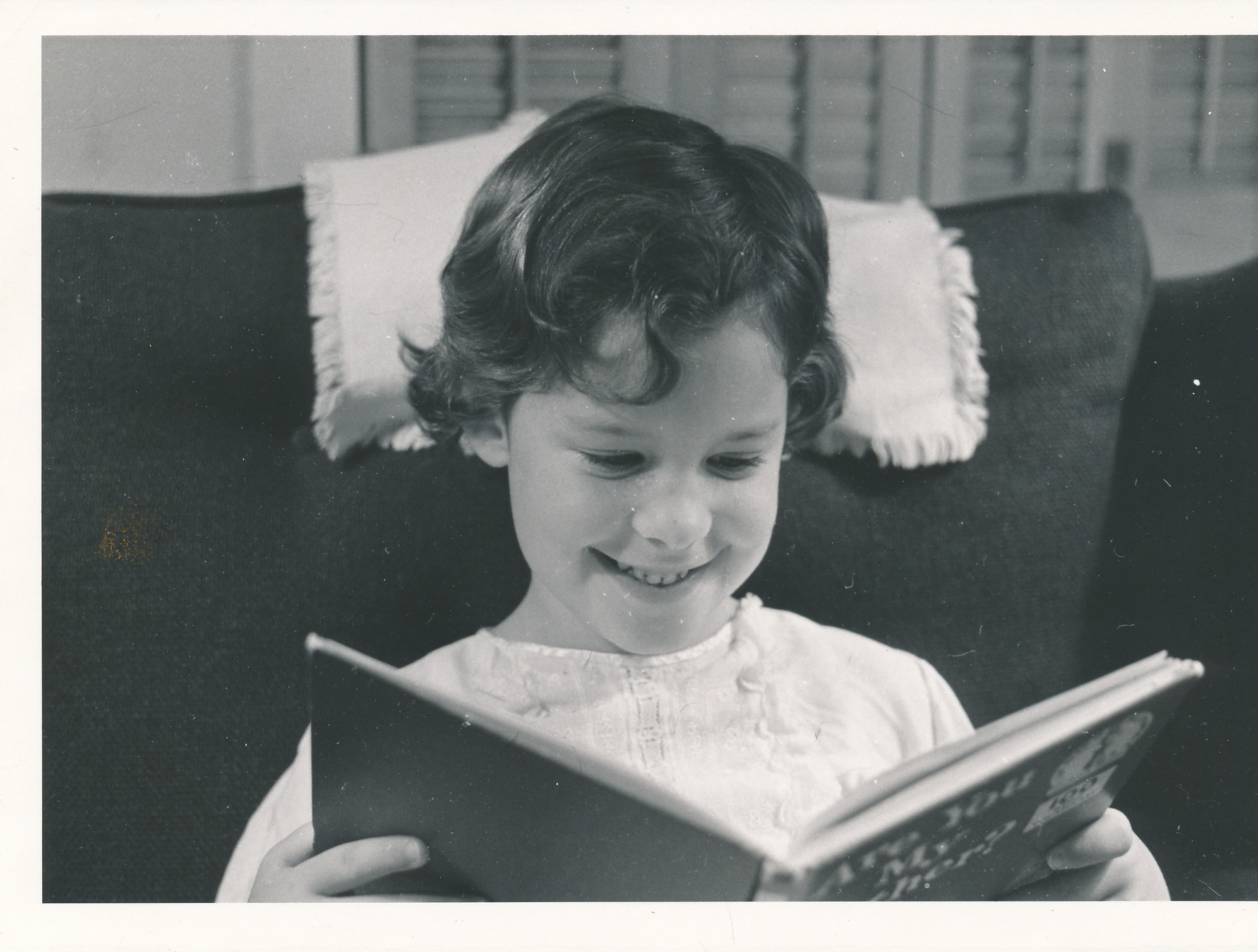
Calyx has just published my essay “Ratification,” about growing up during the fight for the Equal Rights Amendment (click the link to purchase a copy). So here is the third-grader who was spooked by her anti-ERA teacher. She doesn’t look scared, but already she knows that girls aren’t supposed to be too smart. In a few years she’ll replace dresses with Oshkosh B’gosh overalls, partly for comfort, partly to hide her unmistakably female body. Of the time she spent in third grade, only a few moments will be memorable: winning a spelling bee, reading laminated SRA cards, and listening to Mrs. Peerenboom’s threats about the dire consequences of women’s equality.

Posted in Uncategorized | Tagged , | Leave a comment

The Urge for Going

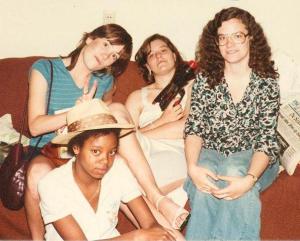
Four of the infamous five: Vanessa (in front), Kale, Maryanne and me

Over thirty years ago I trolled the “Ave” of Seattle’s University District, about a mile from where my family moved when I started eighth grade. At Budget Records, I flipped through bins of bootlegged albums in white sleeves. I still have my record of Joni Mitchell singing early songs like “Urge for Going” (“I get the urge for going…when the meadow grass is turning brown”).

At the Continental Cafe, Greek men smoked on one side, and I spent my allowance on feta cheese sandwiches on the other. Lefties smoked and drank espresso at the Last Exit on Brooklyn, while my high school friends and I ate warm apple pie, dripping with cinnamon sauce.

Those friends — Maryanne, Vanessa, Morgan, and Kale — and I called ourselves “the infamous five.” One weekend we split up and made a game, planting clues around the neighborhood for the other team. My team left a clue under a wastebasket on an upper floor of the art deco hotel at 45th and Brooklyn.

The Neptune Theatre ran “The Rocky Horror Picture Show” for years, and it was a big deal for me to get permission to stay up late for the midnight show.

I bought candies wrapped in rice paper at Shiga’s, slices of pizza at Pagliacci’s, and all of Anne Sexton’s poetry at the University Book Store.

But I got the urge for going after high school. I went an hour south for college, then points east: Washington, D.C., Boston, Minneapolis. When I returned to Seattle in the early 1990s, the neighborhoods around the University District were too expensive for community college teachers, and besides, I was a different person. Arline and I bought our house in the gentrifying neighborhood of Columbia City, and I felt at home, as I had in the diverse, eclectic neighborhoods of Jamaica Plain in Boston and Loring Park in Minneapolis.

But this year, Arline and I are selling our house and moving into a co-op apartment just a few blocks north of the building that once housed Budget Records (long since raided for its bootlegs and gone out of business). It’s a different University District, scruffier; the money has moved away from the Ave, leaving mostly hole-in-the-wall eateries, thrift stores, and copy shops. But the University Book Store is still there, and the Continental Cafe. A great farmer’s market occupies the playground of the old University Heights Elementary School, now a community center.

It’s odd to come home to the neighborhood where I was an adolescent. I can almost see myself, hunched from self-consciousness, my growing-out curly hair whipping around my face, my diary in my rain jacket pocket, as I walk past the building where I now live. I had just turned fifteen when I wrote, “Three more years and I will move out. I mean it.” I calculated that there were 1,070 days until my eighteenth birthday: 25,680 hours! 1,564,800 minutes! 92,448,000 seconds!

And I did leave. And I didn’t look back nostalgically on my old neighborhood, didn’t feel homesick, didn’t miss high school. I was out in the world, learning how to be myself and still survive.

In the last verse of “Urge for Going,” the narrator is the one staying, lighting the fire and pulling up the blankets, while summer wanders away. It’s an exaggeration to say I’ve entered the winter of my years, although time has frosted my hair. I stand in the bay window of our new apartment and look down at the people walking along the edge of Cowen Park. They walk the same sidewalks, beside the same trees that were there over thirty years ago. That’s when a girl not yet of summer, still of spring, shuffled along, yearning for escape. She wouldn’t have thought to look up at the window, to imagine the woman of autumn watching over her.

Posted in Uncategorized | Tagged , | 6 Comments

Partridge Family Feminism

I was seven years old when “The Partridge Family” broadcast the episode “My Son, the Feminist.” Keith, the heart-throb lead singer, offers to play music at a rally for Power of Women because his girlfriend Tina is a member (get it? POW!).  The rest of the family balks, especially when the right-wing Morality Watchdogs warn of a counter-rally.

This episode, which I don’t remember watching at the time, was brought to my attention by Jennifer D. Munro when I was working on an essay that is coming out this summer in Calyx. Every sitcom in the 1970s, it seems, had its feminist show, including “The Brady Bunch” and “The Courtship of Eddie’s Father.” They all, of course, caricatured the women’s movement while signaling some sympathy for it, as long as it didn’t go “too far.” In many of these episodes, the young feminist eventually gets her comeuppance when she realizes she still wants to retain some traditions. Tina pouts when Keith tells her he will no longer walk her to her front door because it’s a “condescending gesture.”

Watching this episode on YouTube, I was surprised not by the caricatured positions (“The family unit is decadent!” Tina complains), but by how little the political conversation has moved for folks commenting on the web site. Within the last month, one person commended Keith for showing “just how things can be taken to extreme. The fact that he didn’t walk her to the door, or kiss her good night and then she tried to censor their music just because of ‘I Love You’ in the lyrics…. [T]here is some validity in how we can take things too far.”

Other posts criticize Tina for being a follower, the women’s movement for being intolerant, and the entire episode for promoting feminism: “No man likes a Feminist type.” Capital F!

Sigh. Forty years later and the “feminist type” is still vilified even though most people now embrace the tenets of the 1970s wave of the women’s movement. The thread that runs from the anti-feminism of 1970 to today? Don’t go too far. Don’t push too hard. Don’t ask for too much.

But too far, too hard, and too much are relative. In one throw-away joke in the episode, Tina refers to the P.E. teacher, Ms. Bangkok (get it?), who is trying to organize a professional hockey league for women. The laugh track predictably laughs. Of course, there have been professional women’s hockey leagues in Canada since at least 1998.

Posted in Uncategorized | Tagged , | Leave a comment

Rituals

Arline and Alma, Panama City

Last year my partner’s best childhood friend died of cancer. Arline changed her Facebook profile picture to a photograph of herself and Alma, dancing on the sea wall in Panama in their high school uniforms. She kept that picture up for almost a year, only replacing it with one of our black lab, when he, too, died of cancer.

Those of us not involved in organized religion sometimes think of ourselves as lacking in rituals, but maybe our human need for ritual asserts itself regardless of how we do or don’t express faith. Changing our Facebook profile has become a kind of ritual. We assert solidarity with a cause or show off our children or, on our birthdays, scan in pictures of ourselves at five, grinning with missing teeth. Just as church-goers can snore through the service or sing out loud, we can engage in Facebook image rituals with varying levels of intensity. I also put our dog on my profile picture after he died, and when, a few months later, I tried to change it to something else, I couldn’t; it felt like a dishonor. Not until my birthday did I feel that I had a sufficiently good reason to change it.

Birthdays, of course, are often awash in rituals. This year my birthday celebration was delayed until my parents returned from a trip, so I put a birthday candle in my frozen waffle in the morning, lit it, and sang happy birthday to myself while Arline laughed from the kitchen.

We recently attended the wedding of our friends Emma and Genevieve; it was an opportunity to think about which rituals appeal to us and which don’t. If we married, I asked Arline, which of these traditions would we retain — the tossing of the bridal bouquet? the parental “giving away” of the bride? the cake? Definitely the cake.

Outside the hall, in the lull between wedding ceremony and reception, we chatted with another lesbian couple about weddings and other life celebrations. The white woman made a comment I’ve heard many white people say, that our culture doesn’t have much ritual left. But I think she’s wrong. I think the rituals are just invisible to us, the same way other aspects of our culture are invisible to us white folks because they’re so dominant. We may not engage in the same traditions our grandparents did or go to a church to engage in them, but we still ritualize our lives. On my birthday, I wanted a candle. When our dog died, I wanted to signal my mourning to the world. Instead of wearing black, I posted his picture on Facebook.

Posted in Uncategorized | Tagged | 2 Comments

Favorite bookshelf

Setting up this web page, I decided to photograph my favorite bookshelf, the one with books by friends and mentors. Since you can’t see all their names, I’ll write them here:

Ursula LeGuin, Tom Spanbauer, Jenefer Shute, and Rebecca Brown all taught me something vital about writing. In their presence, what had been closed in me opened, and words emerged.

Pramila Jayapal, Jennifer D. Munro, Donna Miscolta, Wendy Call, and Sasha Su-Ling Welland have all been members of my writing group at one time or another, and I saw many of the words on these pages in early drafts. I couldn’t write without their faith in me and in our larger project.

Dan Orozco and Nassim Assefi are just two of my many writer friends whose work inspires me. Margaret Atwood, Octavia Butler, and Sherman Alexie inspired me, too, and I’ve been privileged to hear them read their words out loud.

Finally, my father, James Green, set the tone early: writing is hard, but almost nothing is as satisfying as making a good sentence.


Posted in Uncategorized | 1 Comment

Remembering the fight for the Equal Rights Amendment

Looking forward to the summer publication in Calyx of my essay “Ratification,” about growing up during the fight for the Equal Rights Amendment.

Posted in Uncategorized | Leave a comment